Thursday, 28 April 2011

That Inconvenient Timey-Wimey Thing - An Academic Review of the Year

So, a year has passed - at least, an academic one has (Am I the only one who hates how short academic years are?) - and a review of my education is on the cards.

I’ll be honest right now, with everyone: I’ve not been the greatest student this year, if anything I’ve been the nightmare student that all teachers dread. I can do the work, I’m capable, I could even learn to love 3D, but the motivation this year has been severely lacking. It’s not even been something that I could help, or change.

My formative assessment wasn’t the best, to say the least (Understatement of the century). It was quite possibly the most devastating news I’ve ever heard, and hearing Mike ask if it was because of a problem I had with the course made my head spin.

I’ve got no problems with the course - I may have grouched and ranted at first, but I’m putting that down to sheer culture shock. I’d been away from the British Educational System for three years, and it was difficult trying to get to grips with teaching methods over here again.

Personally, I think the course is the best in England - I hunted high and low (literally from Dundee to New Port) and only DMU seemed to offer a fair knowledgeable balance of 3D and 2D. The others were all under funded, under staffed, or focused solely on 3D (I’d have died - it’s one of my biggest nightmares, come to life).

3D is a nightmare for me, always has been. I’m just not good with computers, they con-fuddle and confound me (I even hate Facebook, Twitter and have a general disdain for msn), so I tend to need a bit more help with this class than I usually like to admit. I’m a proud person, and asking for help doesn’t come easily to me at all. Maybe if I’d asked earlier I wouldn’t be having the trouble I am now?

I tried to research and looked at several tutorials online, but I still found myself lost. It felt as though Heather was speaking a different language, and I was the only person in the room who didn’t understand it. I finally got the hang of modelling in low poly towards the end of the year (read: now-ish), but I still find texturing unbelievably hard - it makes my head spin. I’m not the best painter to begin, but having to flatten things and then give them texture? No chance. The silly thing is, I can plan out what I want it to look like in my head, but the moment I try to paint it I end up with a pixelated flat mess.

I haven’t given up, and I’m still working on it, timidly. But every time I get near Photoshop with a texture file, I get the sudden impulsive urge to run for my life.

As I’m so bad at this class, I think any suggestions on my part would be a bit of a joke, to be honest. Though I did think the flow of projects was a bit strange. Instead of going from relatively easy to hard, I though the projects jumped all over the place - going from making and texturing a wheelie bin, to a house, and then down to a tree? Seemed a bit odd, and stressful.

Oh, and maybe remedial classes? Is the hopeful look not helping? Dang…

I’ll admit I found the semester of 2D a little boring, from the technical aspect, but I understand the need to get every one on a level footing in regards perspective, composition and other equally important tools of the trade. But Chris made the lessons engaging and fun with the continual outings, being outside, and drawing things from life like that, really helped me to develop an eye for figuring out perspective, as well as how to compose a natural looking scene.

The second semester of 2D was my favourite class. Ever. Nothing can ever top life drawing, no matter how many times I curse ‘bad drawing days’, nothing will kill my love of it. I’m a firm believer that life drawing is one of the most important lessons an artist can take. Everything in our world is ergonomically design, with humans in mind, how better to understand that than to study the human for itself?

I adored the character projects as well. I might not be the best, technically to create a character (I’ve been told a couple of times that my back grounds are better?) But I just love the entire process of bringing something to life.

The one thing that I’d have liked to have seen along side the life drawing and character projects would have been anatomy studies. I’m generally quite a technical person (until you give me a computer, then I fail), and I know that I’m not the only one in the class. Having an understand of how things are put together - skeleton, muscle structure - would have helped me to create the over all form, especially when designing characters without an immediate reference.

As for Critical Studies, for all I procrastinate on my blog posts, this is actually my favourite class, after life drawing. I love learning about the inner workings of the Games Industry, and just how each person adds to the whole of the production pipeline.

First semester was a bit wearing. I didn’t know what to write, how to write it, how to not sound like a douche. I don’t think I succeeded on that last one. Oh, and I hope I never have to write another introductory post again… Ever. I think I’d end up killing someone out of sheer frustration (maybe the person who invented 3D art applications, and geared them towards programmers). Finding out about the history of games though was interesting, I’d had no idea that it started so early, and thanks to that little detour to the past - and a helpful roommate - I discovered a love of adventure games and walk through novels.

Doing the latest blogs on game design, however, have made me take a step back and look at my own work flow through different eyes. I think they’ve also helped me decide on what I’d like to set as my final goal in life. I remember in my first post I wanted to do concept art, or design characters, but that was more an immediate after university want. It’s kind of grown into something else, and I find I quite like the idea of managing other people, making sure a vision works the way it should (And guys, I promise I’d be way more motivated in this, Easter Break = Soul Searching, though why it couldn‘t have happened sooner I‘ll never know).

Looking back on the year, I wish I’d worked harder. I wish I’d been able to pour everything that I am into the course, instead of sitting here with regrets. But life goes on, and one way or another, I’m not going to give up, pass or fail.

I’ve got a dream that I intend to see through, and two capable hands to make it happen.

Blinded by Anthropology - Environmental Design in Games

A game is nothing without an environment - heck, even Pacman has one, no matter how basic. After all, with out an environment, where would you play? You can’t have a game dependant only on character and story. It’s like literary science.

Unfortunately, every one takes it for granted. Half the time a player will waltz through area after area never really looking at it, or appreciating the amount of effort that went into it (unless you’re a game art student, and then you stop to examine every texture and mesh). But the fact of the matter is that Environment design is often times more difficult and far more involving than designing a character, but the processes and tricks remain the same.

At the end of the day, a game is simply an interactive narrative. This means that everything within it has to tell a story, and the Environment is no different. Unlike the Character, who has to show signs of a personal, individual journey, the World of the game has to tell a story unique to the whole populace - it has to have a history of years or hours, it has to have the scars of time.

Outside, our own streets suffer the same fate - you can walk through Birmingham and see architecture new and old, decaying and well cared for. There are the remnants of parks, and new city apartment blocks, along side old gothic buildings and classical churches.

Detroit is filled with sky scrapers and metal buildings, and the rolling stone scroll work of turn of the century architecture eventually giving way to wood and brick houses, with paint flaking on the walls and unkempt gardens. It used to light up at night, looking like a living wall of stars.

Now, its practically a ruin, after the mass abandonment that followed the economic crash. Some of its most iconic buildings lie dying, degrading into nothing. Detroit tells a story of settlers, change, prosperity, and despair, and I don’t have to see, or meet a single person from there in order to read all that.

Its that kind of realism that environment artists strive to achieve in their designs, that level of detail. They have to create a world the immerses the player, because, as they walk and look around, it seems as though this world, this fictional creation of pixels, has always been there, and always will.

In terms of game play, and level design, there still has to be that sense of realism. If you’re going to use lighting to guide the player down a corridor, it has to come from somewhere logical - a swinging lamp perhaps, or a sky light? If they’re going to find items and weapons and clues strewn about, they should be in logical places, instead of just random littered about. After all, who really keeps an AK-47 in a child’s bedroom?

Close enough, I suppose.

Look ma! I'm a Real Boy! - Character Design in Video Games (Written)

In my last post I ranted on the lack of diversity in character design in games. I realise it was a rant. I am unashamed of this fact, and if it weren’t for my friends glowering at me through the computer screen, I’m sure I’d start another one right now. However, I am armed with sugar, and a good old cup of tea, so hopefully it’ll still my nerves (They’re still frazzled from that dang Google search). Hopefully.

Instead I wanted to bitc-I mean discuss written and ‘acted’ characterisation - what makes an interesting three dimensional character. In truth, it’s a very hard question to answer, solely because there are so many integral facets of great character design that it’s hard to specify the most necessary. But I’m going to give it a shot anyway.


1. Compelling Motive

“I’m off to save the world!”

“Why?”

“… For the lols?”

Admittedly, even the above scenario could work if you played it right, though I doubt it, if that’s the sole motivation you’re going for. A compelling motive is realistic, identifiable, and, most importantly, in keeping with the over all personality of the character.

For instance, if your character is an asshole, they’re not going to save the world, and if they do it’s probably only because they want to get rich off the royalties of being a hero and retire. Or possibly just because it’ll be a chance to kick the crap out of someone and not go to gaol?

Even boredom can be an interesting motive if you play it right.

Conversely, if your character is a hero, chances are they’re not the most self sacrificing person in the world who has to do everything right all the time, without a motive. If they are, turn around and go back to the planning stages, because I think you just made a Mary-sue/Gary-stu. However, if they’re compensating for something - perhaps a case of self image issues, or guilt? - or maybe doing it to protect a family member, then it instantly becomes a little more understandable as a course of action.

As far as motives go, the simpler the better is usually a good rule to live by. This is your characters ambition, the thing they want or need to do most in the world, and at the of the day the player has to believe in it just as much as the character.


2. Interaction

Where would Dr Mcoy be without his dry sarcasm? Buffy without her cheesy one-liners? Deadpool without the internet?

A character who doesn’t interact is boring. Heck, even Link interacts! How does the character speak? What inflections do they put on words, do they gesticulate with their hands? Body language and the inflections of speech are inherently unique to everyone on the planet, it’s pure science. The things we experience day to day, coupled with the way we were bought up, the way we see ourselves and our genetics, alter the way we present ourselves to the world.

Your character is no exception to this.

An outspoken laid back person born and raised in New Orleans, but coming from a well off family, will probably speak with a light southern drawl, though their words would be clipped, and arraigned in formal sentences. Sparse amounts of slang would make their way into that person’s speech. They’d also hold themselves with a slightly slouched - shoulder mildly slacked, and feet an easy distance apart. But their chin would be held high, and spine comfortably straight with confidence. Most probably they’d use their entire body to enunciate, and have a fairly expressive face.

In juxtaposition, someone from Birmingham, England, with the same financial background, would naturally have a straight, more closed posture, and probably use only their hands and expression to enunciate their words.

However, it’s not just this personal, general view of interaction that needs to be taken into account. How does the character treat those around them? How do they speak with their closest friends and family? How do they treat their enemies?

A group of characters who play off of each others insecurities and emotional weaknesses are going to be more interesting than a cast who simply agree on everything and practically act like clones. Heck that’s the reason house does as well at it does. Conflict is interesting: Fact.

Balthier in Final Fantasy XII treats every one with general, sarcastic disdain and arrogance, coupled with ingrained imperialism, with a rebellious streak a mile wide. All apart from his partner, Fran, with whom he seems to have a quiet accord coupled with intermittent humour (up to and including a discreet knuckle bump at one point in the game).

Whereas, Penello from the same game is generally good natured and determined. Though she as she’s fairly quiet through the game she comes off a little shy around stranger, apart from the few moments she’s teasing/berating Vaan (the games ‘Main’ character), or skilfully playing games of politeness with a soon to be Emperor.


3. Personality

A character without personality is like a stone that bleeds. It just shouldn’t happen. Ever.

I’m not even sure it’s possible to define persona-


Personality (noun; n): per-son-alley-ti

The complex of all the attributes--behavioural, temperamental, emotional and mental--that characterize a unique individual.


-…. Thank you Google.


Match Stick Men - Character Design in Video Games (Visual)

Designing characters is one of the most prestigious positions that you can get in a gaming company. It’s the job every one wants, and isn’t without it’s merit, after all, the characters are the thing most players take to heart.

But it’s not an easy job by any means.

Character design encompasses many things. The artist has to be able to convey a personality, way of life, style of fighting, just through the way a person’s face is built, or the what kind of jeans they wear. The build of the character has to reflect how fast or strong they are, the set of their eyes should show the little nuances of their personality.

It’s an easy thing to get wrong on so many levels, but when it’s right it’s spectacular, and you have a character that people are going to remember for generations.

Unfortunately, I’m of the view that the game industry has started to stagnate on this front. Franchises have stuck with certain character types for so long that they’ve just become a cliché, and the moment that something new and interesting is made, it get’s done to death within a matter of months.

For instance, I’d like to see a military first person shooter where your main character isn’t a butch, seasoned officer, but maybe a nervous, green around the ears private? A Sci-fi game where the hero isn’t clad in armour made of plastic futuristic blobs that possibly glow? Or maybe a fantasy RPG where your main character isn’t a noble knight or a simple stable boy?

I understand a lot of this is to with the way games are written as well as the character design, but I do believe that there are interesting new ways to spin old stock characters that just aren’t being looked into. Why? Because the current tropes are ‘safe’.

I’ve also noticed that we seem stuck in this belief that all games have to look photo realistic. Personally, I think that’s a bit boring - this might because I come from an animation background, but I find it hard to believe that I’m the only one. Some of the most interesting design’s I’ve ever seen have come from stylised games - Psychonauts and Grim Fandango, for instance.

I think a horror game with Tim Burton-esque stylisation would be spectacular., or a serious fantasy game, with Disney based designs. It doesn’t all have to be grim dark, guys. Even Lara Croft started off as a cartoon.

I think that if you do go down the realism route though, it shouldn’t be some sort of idealised state of it. For instance, take Faith from ‘Mirrors Edge’, she looks like the ethnicity she is, instead of an over sexualised version. She also has a limited colour palette that adds to the impact her character has, looks wise, which when combined with her hair and clothes makes for a very striking character.

And… Unfortunately I’m actually having trouble finding other interesting characters from the realm of realistic games. This is worrying. So far everything I’ve looked at is all much of a much-ness, and has effectively killed my enthusiasm for this. Depressing considering character design is one of my favourite things. Come on guys, even Korean music videos put in more effort than this!

Okay - I’ve come back to the computer after looking at Disney movies and feel I can carry on.

Maybe I’m being too cynical here, but it seems to be a problem that we face even in Japanese RPG’s, where the default seems to be ‘just how much can we pile on this character?’ (Or, if you’re Tetsuya Nomura: ‘How many belts/zippers can I put on this character before they fall over or the world implodes?’).

As such, there are few games where I can really say I find the characters compelling and visually interesting., let alone unique.

Fable, in theory, should have one of these. The character concepts, on paper, are fantastic! Each face and body shape tells a story, while they’re all tied in together by clothing style and colour palette. However, the personality of those characters got lost somewhere in translation, leaving the final 3D product a little flat, visually.

I adored the look of Team Fortress 2, enough said. It was quirky, funny and design wise just about brilliant. Each character conveyed a distinct personality just through the way they held themselves, let alone the differences in their appearance.

Unfortunately, from most other games in the world, I’d just be picking out random characters here and there.

And that’s just for those who are visually interesting. There are even fewer who I would count as three dimensional enough to be involving as far as written characterisation is involved. It’s a fact that as far as character is concerned, games fall flat. It’s is also a fact, that in order for the games industry to grow, and keep raking in revenue and fans, this is going to have to change.

...

... Just to prove a point.

Tuesday, 26 April 2011

Please Select a Party Leader - Art Direction in Games

There are so many components of art in a game that sometimes its hard to keep track - everything starts to go in circles, and if the left hand doesn’t know what the right hand is doing…well, you could end up with Ninja Golf (Not that anything really could have saved that game - ninjas? Golf? I think my mind just imploded). So how do the great games keep everything straight? How do they keep it all unified and smooth?

Easy - they hire an art director.

Now, if you look up Art Director in the jobs section of Gamasutra, you’ll be hard pushed to try and find one that doesn’t request a list of skills a mile long. Things like ‘Team player’ and ‘Excellent in all areas of art’ seem to come up a lot, along with ‘Must have the patience of a Saint’ and ‘Exceedingly good with small children’, not that I can blame them, really.

Truth is, the Art Director is the one who keeps everything unified, the person who guides the overall vision until its as close to perfect as they’re going to get. Every piece of art, and every 3D model passes over their desk for inspection before being fine tuned and inserted into the final product.

But they’re not just a glorified manager or supervisor, no, they’re job is far more important than that. Art Directors are the visionaries of the studio. To most people Visual Communication is just a word to throw around when nothing else fits, to the Art Director it’s a very real language, and one they have to know fluently in their line of work.

The most accurate comparison that I can give, for visual communication, is that it’s a subtle kind of mind control. You take a scene, a setting, a character a kind of lighting and set of lines and action, and visually bend them to psychologically appeal to the player, to trick them into thinking and feeling a certain way. Something as small as tilting the camera thirty degrees can make a viewer feel uneasy, unsettled, and is the usual lead into a dramatic, villainous or disturbing section of plot. See that forced perspective, looking up at the villain? Yeah, it’s used to make you feel intimidated and inferior. Extreme close up? Totally trying to make you uncomfortable.

However, this is a far harder task in games than it would be in movies. In film, you can plan out every camera angle, and finely control what the viewer is subjected to. In games, its an unfortunate fact that the player is going to go everywhere they can - they’re going to crawl through every hole, find every glitch and just wait for you to trip up so that they can film it, post it to YouTube, and laugh about it for days. Hey, if you’re lucky, it might go viral.

The answer? Try as hard as you can to control where the player goes, through a subtle use of lighting and visual cues, use consistent colour palettes to its full effect, and just try as hard as you can to make everything as interesting and dramatic and believable as possible. Even down to the style and the way things move - how enemies catch the eye, and just what the user interface looks like - have to be carefully calculated an applied so as not to disturb the players experience of the game. Not to mention making sure every body else understands this vision too.

If you think that sounds hard, well… that’s because it is.

It takes skill to be an art director - of the ninja kind (oh, see, back to ninjas). Skill, patience, and plenty of hair to pull out.

Wednesday, 20 April 2011

The Road to Shamballa - The Game Design Process

Game design. It’s kind of like that big pink elephant standing in the corner of the room, winking at you every so often with a coy little smile on its face. You kind of skirt around it now and again, giving a little, mildly frightened, and highly bemused nod to it as you pass by - but you never really ask.

Truth is, I never really wanted to either. I’d adopted a nice, cosy little picture of tiny imagination elves stealing the dreams of gamers every where, and hammering them out into the mythical final product with grins, elbow grease and maybe a jaunty little song or two.

The reality couldn’t be more different - well, apart from the elbow grease, and maybe the songs. Actually, I have to say, I was surprised at how different it is - at least, to my naive, preconceived notion.

Coming from an animation background, I had a fairly well rounded view on how movies, in general, were created, right from the initial idea, up to the final edit. I should have done, the class projects I’d been put through strictly followed that process.

I guess that’s why I went into doing Game Art thinking that the production pipeline would be the same. In some ways, it is, I suppose, but mostly, it’s not.

Game design has to be as structured as it is fluid, it has to think of everything, and leave enough room for change and adaptations. Nothing is set in stone, and that was a strange concept for me to grasp. In movies, everything is laid out plain and clear - you have a script, your storyboards, your acting, animation and sound. There’s a clear structure to follow, that works.

The game’s industry doesn’t really have that. You’ve a basic outline of what you have to do, the process you need to go through, but because you’re dealing with an interactive media - not to mention one that’s forever adapting, changing and becoming more advanced - you aren’t given the luxuries of certainty.

So many aspects have to be taken into account; the story, the game play, the emotion that the creator wants the game to evoke. There’s so much to think about that it kind of makes my head spin.

But there’s no denying that without that process, games just wouldn’t be what they are.

Earlier games like Pong and Pacman, when compared to games of the day are so vastly different, and yet so very the same. Your classic RPG, adventure game and first person shooter are all built around the same basic dynamic - play through a level, gather what you need, and possibly kill things along the way.

But when it comes to the emotion and involvement that they evoke from the player, they couldn’t be more different from those early 8-bits.

It’s the away the game’s been designed that gives them this distinction. It’s the attention to the story, characterisation, game play - every little thing down to how the levels are lit and what the music sound like. Actually if you ask me, music is one of the most important things in a game, next to art and story, for sheer amount of emotion it evokes. Take the video’s below for instance, while a simple example, illustrate this quite well. The original, while still creepy, is no where near as unsettling as the second. That’s because of the way it’s been cut, and the music that’s been added.

Who thought cat’s could be so creepy, huh?

It’s the same with art, you can take a normal room, and when lit one way it can be totally unthreatening, but with the right lighting, or the addition of certain minor features, or changing even just the way the walls curve can make it off putting, unsettling and scary. Colour palette is highly effective as well when trying to influence mood.

This process doesn’t just stop with environment’s though. Characters can be put through the same design process, to just as great an effect, continuing on into animation. A characters motions and body language are often far more telling than their speech.

It’s that attention to detail that can make or break a game. The player has to feel as involved as possible, especially in game’s where the story is a major aspect. Anything that can ruin that submersion into the game should be avoided at all costs.

For instance, Heavy Rain by all accounts was expected to be a great game, but with the constant character switching many people found it hard to follow as it forced them out of the story. Where as Legend of Zelda, a series that’s known for inducing déjà vu with it’s repeating plot line, constantly changes it’s world, but within parameters that are believable for the Zelda Universe.

Gaming is all about suspension of disbelief, about escapism on an interactive level, and at the root of all great game design is a single rule: ‘don’t screw up’.

When Toei Met Nomura - A kingdom Hearts II Review

Back in 2001, two great companies aligned for the project of a life time. Something so epic, so heart felt, and so action packed, that it would make Star Wars look like a contrived children’s show. It’s good for Lucas that they fell short of the mark - but only slightly.

Together Disney Interactive and Square Enix gave birth to ‘The Kingdom Hearts Project’. A game series that followed the world travelling exploits of Sora, a plucky young hero gifted with Square’s signature gravity defying hair, and Disney’s a-typical none threatening weapon. He was followed around by Donald Duck and Goofy, and taken under the tender wing of Mickey Mouse.

Super Villain in the making, AKA:
A young Kamiki Ryounosuke

If you ask me, the kid is doomed to be the next psycho serial killer, but what do I know?
Along the way he would run into classic Disney characters, and fight alongside some of Square’s greatest (read: Emo) heroes, all the while searching for his lost friends, and inadvertently saving the worlds from cute little black things, called Heartless.

All in all, it was action packed, fun and engaging, and full of so many saturated colours that by the end of it you feel like you just sat through a Beetles induced head trip. It was great!
However, I was more than a little cynical when I saw it sitting on the shelf, shiny silver cover glinting in the artificial light of my closest EB Games, like some rejected Pokemon card. It looked so innocuous, so unassuming. That and I’d seen Donald Duck, Goofy and, of all things, Mickey Mouse looking morose on the cover, staring dramatically into the distance, like any battle hardened anime character learns to do by episode 2.

I rose my brow in little more than contempt. You’ve got to be kidding me, I thought as I reached out to take it from the shelf for a closer look. Nothing can possibly be that dumb.

It was the beginning of a deep and eternal love. I kid you not.

1. Plot

The game follows on from Kingdom Hearts I, Kingdom Hearts: Chain of Memories and Kingdom Hearts: 358/2 Days (the most obnoxiously named game ever), once again revolving around Sora as he attempts to save the multi-verse, and several wayward Disney characters from the threat of total annihilation imposed by the Men in Black. Though it is a more mature plotline than its predecessors, it still retains the same Disney fairytale quality.

Men in Black - Oh, and one compulsory woman ...

Sora jumps from world to world, trying to find clues about strange people in black cloaks as well as find his still missing friends, Riku and King Mickey, master of the Universe (Whoever came up with this idea should be shot, now - it’s creepy, and scary, and he vaguely reminds me of George Bush). We see the return of many of the worlds from the original game, as well as a few new ones, though I will note that the diversity of the worlds is reduced from the first game, making for a more compact plot.

Unfortunately Cloud Strife is still in the game, being as angst ridden as ever, but what can you do? At least he looks vaguely adorable while doing it.

2. Game Play

Square is known best for creating Japanese RPG’s, and, to tell the truth, Kingdom Heart’s fit’s the bill completely. It’s a free-roaming Action/Adventure RPG, with a hack and slash style of combat.

The fight system is based on real time game-play, using abilities learned at every level to produce tactical combo attacks depending on button combination. There’s also the inclusion of ‘Drive Forms’, a state of combat that will temporarily make Sora faster and stronger.
The game, as an RPG, is also party based, allowing the player to fight alongside two CPU’s, whose attacks and tactics can be altered from the main menu. The game also offers Guest party characters, who can used instead of Donald and Goofy on particular worlds.

There is also the option to use ‘reaction commands’ during certain fights, that trigger special attacks or cutscene attacks, dealing more damage to the enemy than usual.

I will note that the controls in this game are far more polished than those in Kingdom Hearts I, and subsequently easier to use, though personally I don’t think that detracts from the challenge of the game.

3. Art Direction

Most people look at the cover of this game and think ‘pshaw - it’s just an anime with Disney characters’, and well… they’d be both right and wrong. The majority of the game revolves around Disney’s style, and even most of characters taken straight from Final Fantasy have under gone a redesign to fit their surroundings far better. In all it makes the game take on a childish yet slightly surreal look. For one I’ve never seen people with feet that big in my life - how do they walk!?

As far as cut scenes go, most play out in the style of a Disney movie and several are made to directly mimic the film they’re based upon. In all, while nothing special they’re easy to watch and in most cases entertaining.

I have had some people say to me that they find this game hard to play just because of the colour palette, and truthfully I can see why. The colours are bright. Not just ‘oh hey, every things happy’ - in some cases they’re bright enough to blind you for life (I’m fairly sure that Hercules glows). While it adds to the childish nature of the game, I do think it’s harsh on the eyes. As for lighting… Well. I’m not sure their design team’s discovered the meaning of that yet.

Review

Mickey, what is that pose?

In all, I’m quite fond of Kingdom Hearts II, I have to be honest. I certainly enjoyed it more than it’s predecessors (The fact they’re supposedly ‘cute’ hero stands there and makes subtly sarcastic comments through parts of the game helps).

I love the game play - it’s probably my favourite aspect of the game, and rivals Zelda in it’s medicinal use for stress relief. There’s nothing quite as satisfying as watching small, adorable, black, chattering bug-things from the beyond fly through the air with pained little squeals as your protagonist yells ‘Take this!’ whilst diving at them with an oversized key.
Unlike most people I’ve encountered who like this game, I also have a love of the ‘Reaction Commands’. Yes I know a lot of people consider them cheating, that they made the game too easy. Personally, I just enjoy watching several Disney villains die in kick-ass cinematic take downs, before everything goes into slow motion.

On the other hand, I found the drive forms mostly useless and a tad defunct considering you can’t use them in half the boss battles that they’d come in handy for. It was fairly awkward to switch between drive forms as well, as you had to search through two menus to select them. Then in order for them to remain effective through out the game, you had to take the time to level up each Drive Form. There were five of them. Six if you count Anti-Form - the only redeeming thing about the drive system, and even then, only because they put way too much thought into it (Seriously, it‘s on a cumulative points system, affected by which forms you use, when, and how often).

Story wise, I quite like this game, the plot line is fairly in depth but still easy enough to play without really having to think about it every second. It’s got several compelling characters, and interesting twists to both plot and worlds (Including one world where the entire system is based around songs, of all things). However, even I can admit it’s utterly childish at times, not that that’s a bad thing, though.

Art, bah… Art. Someone should really, and I mean really, tell square feet don’t work that way. Every body has clown feet! Some even have flippers, for crying out loud! I’ll also be the first to say, that in some areas the animation really isn’t great, and that’s understating it, however, in contrast, half of the game has Pixar level animation so…

This isn’t a game for people who want grim dark, no matter how in depth and serious the plot line gets, the over all nature of the characters just wont let it get that bad, even in the games that have followed. It is however a game for people who are Disney fanatics, Final Fantasy fans and all round want a great, easy to play game with ups, downs and bad songs. Oh, and a healthy love of power rangers as a kid would help too.

I’d give this game an 8 out of 10, for sheer audacity and cute factor. That, and one day, Sora will take over the world - and worse, we’ll like it.

Tuesday, 19 April 2011

A Downward Spiral of Cynicism - Journalism and Games

In a world where the video game is one of the most popular forms of entertainment, it was bound to attract it’s own critics, it’s own ilk of reviewers - And they come in all shapes and sizes.

From the smallest review in ‘neo’, to paper exposes in X-BOX Magazine, chances are you wont be able to walk into a WH-Smith’s or seven-eleven without seeing at least ten games related headlines. As for the internet… well, YouTube is packed with people just itching for the chance to shove their views on the latest ‘Resident Evil’ down your throat.

Personally, I can’t take any of them seriously.

I’ve tried reading ‘Gamers’ magazines, and slugged through the tedious ‘5 out of 10 for graphics! But there wasn’t enough blood splatter!’ that cater to the most hardcore fan-boy. I have to say, most of the articles you encounter will be just that - something aimed at making a crap game, with a huge following, look great. Why? Because chances are, the company that made it are paying those poor journalist's wages.

I’ll admit, I’m highly cynical when it comes this, but when IGN labelled ‘Call of Duty: Black Ops’ an 8.5 out of 10, can I really be blamed? The game was just a walk through movie from start to finish, and was far too short for the fifty pounds plus I’d just paid for it (I won‘t even mention the same-y game play and unimaginative construction of single player campaigns). I realise, I’m opening myself to a slew of hate here, but really IGN? Really?

And am I the only one who remembers the kafuffle with GameSpot a few years back?

I suppose that’s why I mainly troll through private Blogs for my reviews (if I even want to read them - more often that not I’m inclined to just listen to a friend), but even then I find a startling amount of people will base their opinion’s on the hype, or the ‘coolness factor’ - “Will people think I’m awesome if I like this game!? OMG, what if they hate me for it!” - instead of the games actual merits.

I think one of the worst cases I came across, was a poor fellow who describe Final Fantasy XIII as having ‘innovative and exciting new game play, they likes of which we haven’t seen from Square before.’ Indeed, I’d never played a Final Fantasy game that was impossible to get lost in before. All I had to do was point and go, one straight line from start to finish.

Saying that though, I’ve found a couple of video reviewers I like to watch - mainly for the humour factor. The Spoony Experiment is one I find myself favouring - even though he seems predisposed to hate most things, his video’s take on a certain amount of cheese that just reminds me of Mystery Science Theatre 3000 (though nothing can beat that). I like the way he plays out a story along side his reviews. Too many people just look at a camera and talk… and talk… and talk.

Another source I trust is GiantBomb, the result of that kafuffle with GameSpot. It has an editable wiki as part of it’s review system, so the fans (and any other person who can be bothered) are the one’s you’re hearing from, as well as the professionals themselves. Though my favourite section are their endurance runs, who said grown men and women playing games for days on end, until starved, sleep deprived and pixel blinded can’t be funny?

In all I think no review is going to be impartial, but the least you can do is be honest about it.

Wednesday, 17 November 2010

You Spoony Bard (A Personal History of Video Games, aka, Confessions of an FF-aholic)

You know those people who collect songs as defining points in their history? Like, my friend, Cassia - Every romance and break up has a song that she can’t bear to listen to because of the memories.

I guess you could say I’m like that with games. I remember getting my first console - the handheld gem, GAMEboy - with pokemon yellow, and thinking I was the coolest thing ever, because I had a pokemon game. I was ten, and doing my SATs, and I remember putting off studying just to play, and was the first game that I’d completed properly (because playing Ocarina of Time on the N64 at my mates, doesn’t count in the slightest). Unfortunately, Pokemon was a craze that would continue on with me.

I got Pokemon Gold in 2001, and was fearful to open it because it was shiny and I didn’t want to spoil it. It was eventually my cousin who clipped me about the head saying: “What’s the point of having it if you’re not going to play it? Besides, I have silver and want someone to trade with.” I remember being so impressed by the fact that it wasn’t monochromatic - I practically danced. And that your Pokemon actually had a gender!? My gosh, golly, gee whiz! It was awesome - ah the simpler times, when we were all so much easier to please.

The last thing I got for the game boy (which still, to this day, rests in my wardrobe, god bless its weary soul) was Legend of Zelda: Oracle of Seasons, later that same year. I played it once, and have been unable to since. I’m not sure why. It could have been something to do with awkward controls. I was never really fond of the game to be honest. But it was a Zelda, and therefore deserved some kind of honorary play through - even if its now serving as a dust collector.

I think I was fourteen (probably younger) when I got my PlayStation 2, my mum had me do a treasure hunt, finding clues around the house to track it down. I loved it. I just didn’t know what to play on it - I hadn’t discovered final fantasy yet - and so my dad ended up using it more than me. Now its rare if you see the controller leave my hands (as I type, I’m playing Kingdom Hearts 2 one handed).

When I was sixteen we moved to Canada, and this is where the fun began. My animation peers took me under their wing, as the youngling of the class, taking it upon themselves to teach me all they knew of everything to do with geek-dom. I, of course, didn’t protest. Within the space of three years, I’d worked my way through three Final Fantasy’s, five Zelda games, a slew of Mario games, All the Kingdom Hearts games (apart from final mixes), and had become a pro in Super Smash Brothers Melee, and powned all as Link in Soul Calibur. I’d also decided, without a doubt, that I wanted to work in games, and gained a PS3.

The best, and first, Final Fantasy that I worked my way through was Final Fantasy XII - Balthier is one of the best characters I have ever encountered in a game, and the story line is fantastic. The only complaint I had was that it wasn’t long enough.

Ah, and I remember trolling up and down Windsor high street, and Devonshire Mall, looking for a copy of Legend of Zelda: Twilight Princess, only to break my arm before the last boss. Thusly Ganondorf was defeated using only one hand. This is not easy.

GAAAACKT!!!On returning to England, I bought a PSP (purely for Dissidia: Final Fantasy, only to fall in love with Final Fantasy VII: Crisis Core), and play it religiously to this day, along with my borrowed DS (I love you mum!).

Which.. Pretty much brings us up to date, as I play through Ookami, one of the best 2D-effect games I have ever played. It’s innovative, involving, and aesthetically beautiful. I’m also playing FFXII for the twenty-fifth time, Kingdom Hearts II, and Kingdom Hearts: Birth By Sleep. Oh - and mustn’t forget Dragon Age: Origins, a game that I’m giving a second chance to win me over.

And As this post is now over seven hundred words, I’ll take my leave, and bid you adieu, auf wiedersehen, and good night.

The President has Been Kidnapped by Ninjas (aka, A History of Video Games 2000's)

So, after the nineties, we’re stepping into the nought-ies with the next decade of Video Gaming, bringing us bang up to date at the end of it.

This era (one I am very familiar with) was dominated by the console - Sony, Nintendo, and, new to the market, Microsoft, duked it out becoming the big three of gaming. It also saw the rise of the hand held console. The GameBoy, evolved, transforming into the GameBoy Colour, the GameBoy advance, until it reached the DS level. Along side it, we saw the birth of Sony’s PSP.

This decade was also the graphical explosion. Every game was more advanced than the last - they looked better, played better, the technology used in their creation grew at an exponential rate. From the blocky graphics of Spyro, into the fully rendered, and fantastical worlds of Final Fantasy XIII (awful game, but it looked great).

In the year 2000, Sony wowed the market with the PlayStation 2, named the third best video game console by IGN. And, due to several delays (that

I remember well) it couldn’t be found anywhere. People were buying for hundreds of dollars, if it hadn’t tipped into the thousand mark, over the internet, j

ust to be able to own one.

It wasn’t until 2001 that is was more widely available, with a smash hit line up of games, that fended off its competitors of the time; the Nintendo GameCube, and Microsoft’s Xbox.

The Xbox, however, came compatible with online console gaming, utilising the function to make multiplayer games using the internet. It was also the first console to have an inbuilt storage facility for saving games, and downloading from ‘Xbox Live’ - removing the need for memory cards (which I know I lost several times, for my PS2).

Last, but not least, was the GameCube. Released in 2001, it was the third console of Nintendo’s to connect to the internet, through the use of a special adapter

(though very few games were released that made use of this), and the first of its consoles to use CD-ROMs to run its games, instead of cartridges, that had a limited life span.

By now, 3D was standard on console gaming, common among RPG’s and First Person Shooters, and from there, it could only go up. With the console war settled into the three main competitors, the race was no longer about the hardware, but rather the software. This allowed for an exploration into graphics. The look of games became more sophisticated and polished, and that, in turn affected the gaming audience. It became standard for games to look good - the better looking the game, the more interest it garnered from fans.

Similar advancements were made in aspects of game play. User interfaces became more intricate, and there were more options applied to game play. The player could affect more of the surrounding worlds - some games (-cough- Fable -cough-) going so far as to change the look of the world and the people in it, as well as scenarios, depending on the choices the player made.

Unfortunately, this generation of consoles, came to an end, all too soon, as the new seventh generation was born. 2005 gave rise to the Xbox 360, and 2006 ushered in the Wii and PlayStation 3. A new frontier of gaming, so to speak - better hardware, more capabilities, and motion control.

The Wii was the first motion control console, using the wand controller to direct a cursor on screen, and the buttons to execute different commands. It’s graphical capabilities, however, weren’t much higher than the game cubes, but the possibilities for game play were exponential.

On the other hand, the PS3 was more focused on graphics, indeed its first line up of games showcased as much, verging on the closest thing to realism seen on a console. However, most of the line up games had sacrificed on game play, and as such, the Wii had a better launch with its star line up (an Legend of Zelda leading the way, with Mario games to follow, it was a sure hit with nintendites, where as all of Sony’s major titles didn’t hit the shelves for the PS3 until a few months after launch).

However, the 360 was a happy medium of both. With much the same control as before, the graphics and hard drive were both upped, allowing for a better gaming experience, which is possibly why it is becoming one of the more common consoles.

And, zapping right into the last few months, both the Xbox 360 and the PS3 have seen the implementation of motion control with the PS3’s ‘move’ controller (far more sensitive than the Wii controller, and at the moment, slightly more accurate) and the 360’s Kinect (made on the idea of using the full body as a controller), which saw its formal release last week, and instantly sold out.

I can safely say the Kinect saw much use in GameStation the week of its release…

Mostly by the staff.

Wednesday, 3 November 2010

Blinky, Pinky, Inky and Clyde (A history of computer games 1980s-1990s)

So kiddies, you may remember my post two weeks ago where I chatted about the early roots of Video Gaming. Well, this week, we take a turn for the modern (whether or not that’s a good thing, I’m not entirely sure), by taking a look at the latter part of last century, where games have gone from the clingy novel little infants, and grown into moody teenagers who bicker and fight at every given opportunity.

In the 70s, with the rise of the personal computer, also came the first home gaming console, in 1972 to be precise. The Odyssey was produced by Magnavox, and came with a total of twelve programmed games. Of course, the fact that they were all the same game, only differing by the plastic sheet you attached to the TV, meant nothing at all. Nope.

Next in line was 1976s Fairchild Video Entertainment system, the first programmable gaming console. It was later renamed Channel F, and used microchip technology to run its games.

Vintage Vectrex

Now, entering the eighties, came the rise of computer games as we know them - worlds on a screen that would be impossible in real life. In 1977, the first text based adventure game was created, named, oh so originally, as Adventure! and worked on a choice system. It’s from that model all other adventure, science fiction and generally spectacular fantasy games are created from. In the eighties, this genre became known as ‘Interactive Fiction’ (And of course, this part interests me, as it’s the birthplace of my favourite gaming genre - long live the Action/Adventure RPG!), and produced games such as ‘The Hobbit’, an adaptation based upon Tolkien’s books. This is also where the nineties computer based ‘point and click’ RPG’s came from.

It was also during the eighties that colour first appeared on screen, mostly within arcades, but, towards the end of the decade, it was rampant on home consoles as well, introduced by ‘Breakout’ Atari’s latest remake of Pong (created by two men who would become the founders of apple - but that’s another story, for another time). I was driven further by games like Galaga (that utilised 8-bit colour). Sound, also started to make an appearance - again, in the arcade, with Taito’s 1980 Stratovox.

Atari System

Now, Who remembers Donkey Kong? I know I do. Platforming game came about in 1981, with a little game called ‘Space Panic!’, where mutant, alien space-apple try to devour your hero as you climb up ladders and run across levels. Of course, this was also the year ‘Pac-Man’ was released. All hail the day! He subsequently gained a Mrs the following year.

By the end of the era, consoles were on their fifth generation, accessible to most, and quite affordable. Arcades had come, and gone, fading into the ether by the mid nineties, overtaken by their more personal comrades, the console, their demise confirmed by the release of the Neo-Geo by SNK - the only console to truly bring home the feel of arcade gaming, since the early home Pong systems. And games themselves had gone from simple, one paddle pixels on a screen, to several pixels, a depth of colour, and ever evolving game play and graphics, with a slew of top titles, each innovative and memorable.

In the mid nineties, the consoles we all know were born - 1995 heralded the PlayStation (And with it, Final Fantasy‘s VII-IX), the major selling console of the time, and Nintendo 64 in 1996 - All Zelda fans, cry for joy - Ocarina of time, oh how I love thee - and with them came fully 3D graphics.

Things were beginning to get rolling.

Tuesday, 2 November 2010

Magical Folding Canoe (AKA That thing last Wednesday, and life in general)

Ah, Advice - the building block upon which the world was built. Sometimes, I wonder just who gave the first piece of advice - then I realise I don’t really care, I’m just thankful that I get any. And what could be better than advice from the Pros?

Most of it, I’ll admit, was just common sense: Be polite, work hard, get good grades, don’t send in crap-tastic work or foxes in underwear (That, shall forever be burned into my mind… and yes, Craig, I’m looking at you). But there were some serious gems in there.

I’d thought that to be accepted, you pretty much had to excel in 3D - in fact, I was a little scared. I’ll be the first to tell you that my 3D stuff isn’t great, and I struggle with it, but at least now I know that while I should still put the effort into being the best I can at it, I’ll also be judged on my 2D skills. Can anyone say ‘sigh of relief’? I know I can.

Also as we discussed the other jobs available in the art, I was interested to learn about the concept artists. I hadn’t given much thought to the position at all before, but now I think I’m going to look into it more. As I said, I feel my 2D work is my strongest asset, and if I can put that to use, then why not?

I’ve also decided, that even though I’m not in that field anymore, I’m going to keep my animation skills strong. I know it’s a weird thing to say, when they were all ‘Specialize! Specialize!’ but I’ve found myself relying on a lot of the knowledge I gained on that course lately and I feel its best to keep my options open on all accounts for the time being.

Anyway - I’ve started waffling, haven’t I?

The lecture was awesome, the guys were awesome, and the examples of Blitz’s work that they showed had me glowing green with envy. Especially the digital paint stuff. I’ve never been a whiz on Photoshop, and its something I think I’m just going to have to plough through. I’ll have to start doing that ‘speedtacular’ exercise on Facebook, and see if I improve.

All around though, it was an enlightening look into the business - though the amount of work they have to do towards deadlines scares me (just a little). If I’m honest, a lot of the topics they bought up, I’d never considered before, like going out and taking photo’s of real life. I’ve never owned a digital camera (Sure, and old disposable film one, yeah - who hasn’t? But a serious one? Never), and I’m probably the furthest thing from a photographer you will ever meet, but I’d never looked at it that way before. I suppose because even though its amazing, I take the real world for granted: ‘Oh, it’ll still be there when I need it!’ …Any body know where I can get a camera?

On other thoughts, I hate texturing. With a passion.

Wednesday, 20 October 2010

It was a Triumph (The History Of Computer Games)

Unfortunately, being the teeny-bopper that I am, I’m too young to remember the very start of gaming (My friends reminiscing of the ‘arcade years’ that somehow seeped into the nineties in Northern America, are the only basis I have for things like: Donkey Kong, Space Invaders, Pac Man and the very first run of Street Fighter). I’ve seen vague cave paintings of pixel games and heard the elusive fairytales of ‘Pong’ and ‘Atari’.

Of course I know the facts (What little you can really discern from the inconsistencies of any source on the matter); that gaming as we know it started in the 1950s and grew exponentially, resulting in the console wars of the 1980s, until it became the graphically enhanced retellings of Pacman and Space Invaders we know today.

Space Wars

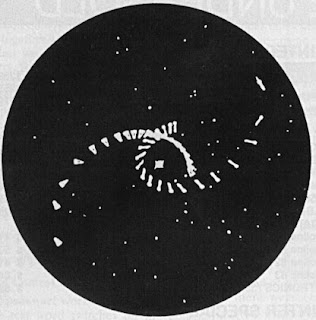
The first game, that I can find, that’s classed as such, was ‘Tennis for Two’, created in 1958 by William A. Higinbotham (All hail, the almighty gaming god) to play upon an oscilloscope attached to an early analogue computer. It was designed as a means of education, albeit an entertaining one, as the user interacted with the ball’s trajectory on screen.

Of course, as all great inventions of the past, and ever to come, someone just had to go a step further. In 1961 ‘Spacewars!’ was created - hailed by many as the first ‘real’ video game. It took a concept that was impossible in real life, and made it possible on computer. It was a labour of love, born at MIT, to the creators Steve Russel, Wayne Witanen, and J. MartinGraetz.

But it wasn’t really until the late 60s early 70s that computer games, as we envision the term, were truly created. Finally ‘personal’ gaming was available. Admittedly it was still large, clunky and you couldn’t have had it sitting in your living room (unless it was the size of a warehouse.. Perhaps I over exaggerate? Just a smidge?), but it was there, and it would grow.

By the eighties, it was war. On a global scale.

Console after console duked it out, some crashing the moment they were launched, others living for years before fading into obscurity. Lack of trading standards meant that pirated games were every where, each console mimicking, and trying to out do the others, until only the most vicious were left.

I, as I said, am too young to remember the carnage and bad adverts, but I’ve no doubt Mike shall subject us to them. Personally, I didn’t start gaming until I was ten (heck, we didn’t own a TV until I was seven or so), my first console being Nintendo’s hand held flagship the Game-Boy Colour. I, like many mindless minions of Japanese TV, owned several Pokémon games. They now sit at the back of my wardrobe, never to be seen again.

After that, it was a PS2 - that I ultimately adored, but lacked any friends who were into gaming, and was subsequently lost - constantly buying ‘bad’ games. It wasn’t until I went to Canada that I started to game in a serious manner. It started with Ocarina of Time, delved into the entire Zelda series, then flitted over to Final Fantasy (I through XIII) taking various meandering roads to things like Mass Effect, Fable - and, of course, Portal.

Remember, it’s in the basement…

Sunday, 10 October 2010

Ah, Introductions...

Alright guys, here it goes. An introduction post - the very bane of my existence. ‘But why?’ I don’t hear you ask, ‘Surely they are the easiest posts in the world to write!?’. Lies, I tell you, all of it. I’m primarily a fiction writer, and would much rather have people pry into the lives of my characters than be forthcoming about my own, boring meander through the world.

If things become a tad droll, you have been warned…

My names Jessica - please, feel free to call me Jess - and I’m currently a first year game art student at De Montfort University. Of course, its been a long hard trek to get there: knee deep in snow, and up hill both ways.

I’ve come armed with a foundation Art and Design diploma, which was preceded by a two year stint studying Animation - both traditional and three dimensional - in Saint Clair College, Canada. There, I gained a fundamental knowledge in 2D skills and basic 3D modelling and animation, as well as the some what strange and distorted sense of humour that you have to develop when dealing with Animators.

My Life pretty much revolves around my love of gaming, movies and cartoons. I can sit in front of a screen for hours, so long as what I’m watching or playing is captivating enough to hold my attention. As far as games go, I must guiltily admit an undying love for RPG’s, fantasy, and anything science-fiction. However, besides my art, I also enjoy writing - both silly little scripts, and short fiction pieces.

I suppose, really, I stumbled my way onto this course - half blind, and confused. I’d known for a while that I wanted to work on games - on bringing them to life, on realising a writers vision through art or movement. But, it wasn’t until I put serious consideration into it as a career choice that I found the multitude of art courses, specifically tailored for games.

Choosing De Montfort really wasn’t hard - it had everything I wanted, would teach me everything I needed, and the most important thing of all, when I met the upper years and the lecturers, I felt comfortable. And of course, that is something I’ll need if I’m ever going to achieve my goals.

My ideal job would be to become a character artist (One day, in the far future, hopefully a lead character artist, or even an art director). It’s something that I’ve been looking into since I started my animation course, four years ago, and I know that in order to achieve that position I’ll have to work hard, developing the skills I’ll need in the industry.

From the research that I’ve done, I know that I’ll have to have in depth understanding of anatomy - both human and otherwise - as well as extensive knowledge in expressions, bone structure, body language, and know how to convey a characters personality simply by the set of their jaw and the stance with which they hold themselves. I’ll also need to develop my colouring skills (a weak point of mine, as it stands) to be able to choose thematic and corresponding colours for the characters that I create.

Many of the job descriptions I’ve looked at ask for excellent concepting, modelling, texturing and lighting skills. It’s the last three that worry me most. I’ve had prior experience with 3D programs, and find it to be one of my weakest abilities. In order to over come it I’ve already planned out several side projects to complete along side my course work, so as to practise the skills that I’ll develop until they’re an ingrained reflex. I also found that the two main programs they ask employees to be fluent in are 3D Studio Max, and Maya, so in turn I shall endeavor to learn both these programs to the best of my capability.

Though it probably sounds excessive, I also wanted to learn scripting for 3D Studio Max, as well as take up a couple of language classes, to make myself a more desirable employee. Hopefully, somewhere while doing all that, I’ll retain (or possibly develop) a personality that will mesh well with the industry, and a sense of humour wouldn’t go amiss, I’m sure.

At the end of the day, this is my future - I’m not just playing games any more.